
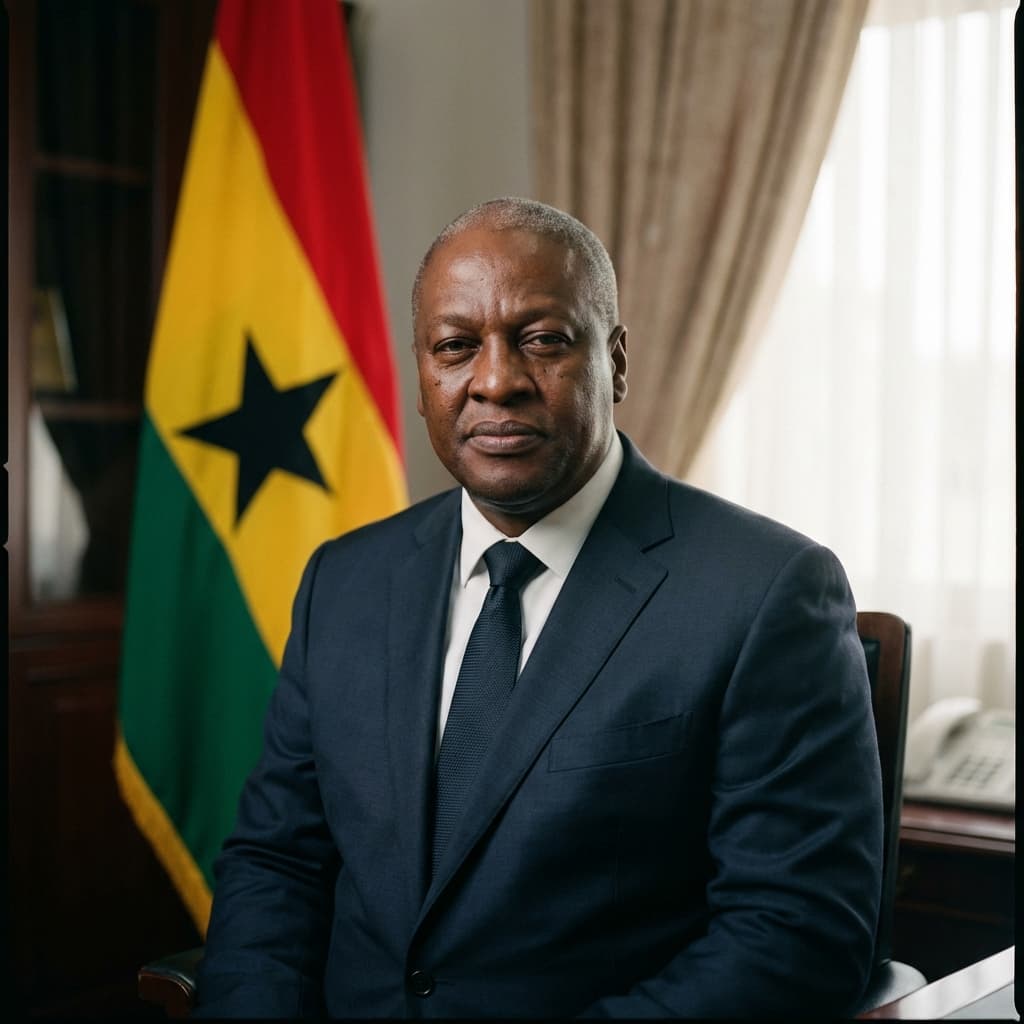
Presiding Bishop Emmanuel Nash, CEO of Ghana Leadership Awards with the Motto: 'Love your country and Love your people' and head pastor of the International Dayspring Gospel church-IDGC, has expressed profound insights regarding President Mahama’s third-term presidential mandate. Based on research carried out by the analytical centre of Ghana Leadership Awards, there are significant calls from sections of the Ghanaian population for John Mahama to serve a third term, driven by his performance and the belief that his experience is needed to address current national challenges.
In 2025, President John Dramani Mahama has been praised following a stabilization and appreciation of the national currency, the cedi, which led to a reduction in the prices of some goods and services. Notable examples include fuel prices dropping from GH₵17 to GH₵12.88 per liter, and cement prices falling from GH₵120 to around GH₵82. Mobile data prices also saw a 10-15% increase in value for the same price after ministerial intervention.
While presidential term limits in Ghana are 'entrenched provisions' within the constitution, making them difficult to change, legal experts suggest that if a government achieves a significant mandate and parliamentary majority—like the NDC government under Mahama—the constitution itself provides pathways for amendments. Some political allies claim that popular demand or the 'will of the people' should take precedence, suggesting the law could be 'tested' or amended through a referendum.
The process for such an amendment would involve: 1) Parliamentary Approval: Requiring a significant majority vote, such as two-thirds (185 seats), which the current government holds. 2) Public Referendum: A direct vote by the electorate on the specific issue. For a change to pass, it requires a national majority of voters, with at least 40% voter turnout nationally and at least 75% of those voting in favor of the amendment.
Other legal steps may include a review by the Council of State or a Supreme Court ruling to ensure constitutional integrity. Bishop Nash emphasizes that the modalities for a third term have been laid, and this potential should not be taken for granted in the interest of the country. The populace's happiness is attributed to the 'socialist' nature of the administration, which prioritizes social welfare over pure profit and competition.
H.E President Mahama is practicing a mixed economy model—an economic system that incorporates elements of both capitalism and socialism. In this model, resources are distributed based on societal needs, aiming for an equal distribution of wealth. The government intervenes through regulation, taxation, and social welfare programs to address market failures and ensure equity.
Recent economic successes are primarily attributed to cedi appreciation against the dollar and a range of new economic policies. This includes the abolition of several taxes such as the E-Levy, Betting Tax, and Emission Tax, as part of campaign promises intended to reduce the financial burden on households and businesses. Internal cost-cutting measures, such as reducing fuel allowances and travel budgets, have also generated fiscal space.
Sector-specific reforms play a crucial role: 1) Agriculture: Investing heavily in modernization and infrastructure to boost local production and stabilize food prices. 2) Industry: The '24-hour economy' policy offers incentives like cheaper electricity and tax breaks to enhance competitiveness and boost local production for import substitution. These factors collectively contribute to the perception of a positive economic shift.
Supporters argue that Mahama's experience is vital for stabilizing the economy and restoring investor confidence. Citizens and groups, such as market traders, believe Mahama's performance in infrastructure, education, and economic management exceeds previous records. As a stabilizing and experienced leader with international roles (ECOWAS, AU), the demand for his continuity remains high. The ultimate question is: can President Mahama say no if the outcome of a referendum says yes?
ANALYTIC CONTENT: RESEARCH FINDINGS BY THE ANALYTICAL CENTRE OF GHANA LEADERSHIP AWARDS
• Economic Mandate: Stabilization of the Cedi (from GH₵17 to GH₵12.88) and reduction in cement prices (GH₵120 to GH₵82) have created a strong 'performance-based' argument for continuity.
• Constitutional Pathway: Analysis indicates that the 2/3 parliamentary majority holds the key to Article 66(2) amendments, subject to a national referendum with a 75% approval threshold.
• Policy Innovation: The '24-hour economy' and mixed economy models are viewed as structural shifts intended to address long-term unemployment and import dependency.
• Popular Demand: Qualitative research across market centers and urban hubs reveals a preference for 'stabilization over rotation' in the current economic climate.